


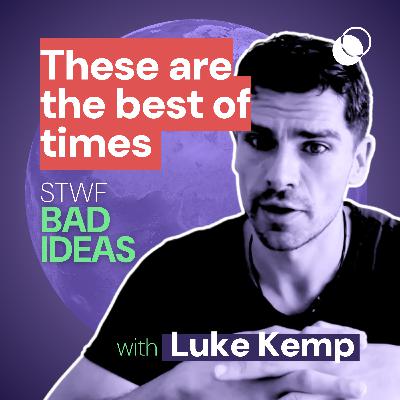
Bad Idea #23 "These are the best of times" with Luke Kemp
Description
🔍 Episode Summary Is civilisation inherently self-destructive? In this episode of Saving the World from Bad Ideas, Mark Lynas is joined by political scientist and existential risk researcher Dr Luke Kemp to tackle Bad Idea #23 "These are the best of times"
Luke unpacks what history really tells us about the fate of past societies — and how those lessons do (and don’t) apply to today’s global risks like climate change, nuclear war, and AI. They explore the role of complexity, fragility, and inequality in collapse, and why we need to reject fatalism to build resilience and renewal instead.
From ancient Rome to modern techno-capitalism, this episode explores whether doom is destiny — or a bad idea we need to outgrow.
🧠 Topics Discussed
● 📜 What “collapse” actually means, and why it’s more often transformation
● 🏛️ Why Rome never really “fell” — and neither did most civilisations
● 🌍 Global risks vs. local collapses: what makes our world different
● 🔁 The role of feedback loops, fragility, and complexity
● 🌡️ Why climate change is a multiplier of collapse, not the root cause
● 💣 Nuclear war, AI, and engineered pathogens as existential risks
● 🤖 Why AI doom scenarios may be overhyped (and misdirected)
● 🧠 “Collapsology,” survivalism, and the new secular eschatologies
● 🌱 What real resilience looks like: democracy, equity, adaptability
● 🧘♀️ Why pessimism is lazy — and optimism is an active choice
👨🏫 Guest Bio
Dr Luke Kemp is a political scientist and risk researcher at the University of Adelaide and the University of Cambridge's Centre for the Study of Existential Risk. He co-led the influential 2022 paper Climate Endgame and has written widely on societal collapse, risk cascades, and global futures.
A former adviser to the Australian government, Luke specialises in the intersection of history, complexity science, and future risk. His current work focuses on resilience and renewal in the face of polycrisis.
📚 Recommended Reading & Resources
● 📝 Climate Endgame (2022 paper) – https://www.pnas.org/doi/10.1073/pnas.2204269119
● 🌐 Centre for the Study of Existential Risk (CSER) – https://www.cser.ac.uk
● 🧠 Luke Kemp research profile – https://researcher.sydney.edu.au/researcher/51183
● 📖 Jared Diamond – Collapse: How Societies Choose to Fail or Succeed – https://en.wikipedia.org/wiki/Collapse:_How_Societies_Choose_to_Fail_or_Succeed
● 📖 Joseph Tainter – The Collapse of Complex Societies – https://en.wikipedia.org/wiki/The_Collapse_of_Complex_Societies
● 📖 Kyle Harper – The Fate of Rome – https://press.princeton.edu/books/paperback/9780691192062/the-fate-of-rome
● 📘 Our Final Hour – Martin Rees – https://www.basicbooks.com/titles/martin-rees/our-final-hour/9780465068630/
● 📗 The Precipice – Toby Ord – https://www.hachettebookgroup.com/titles/toby-ord/the-precipice/9780316484911/
● 🎧 Collapse: The End of Everything (podcast series) – https://www.bbc.co.uk/sounds/brand/m001qbpr
💬 Quote Highlights
“Collapse is rarely the end — it’s usually the start of something new.” — Luke Kemp
“Rome didn’t fall — it transformed over centuries. That’s not a Hollywood ending, but it’s a real one.”
“Climate change is a risk multiplier, not the root cause of collapse. The real danger is fragility and inequality.”
“We need to stop treating resilience like a buzzword. It’s a system of systems — democratic, equitable, adaptive.”
“The biggest myth is that doom is destiny. It’s not. We have choices.”
🌐 About WePlanet
WePlanet is a global citizen and science movement challenging bad ideas and championing evidence-based solutions for climate, nature, and human development. Learn more at https://weplanet.org
📥 Join the Conversation
💬 Feedback or questions? Email: podcast@weplanet.org 📩 Subscribe to new episodes: https://www.weplanet.org/podcast
👁️ Follow us on Twitter/X: https://twitter.com/weplanetint






 United States
